AI AGENTS
Building and using AI agents - multi-agent systems, autonomous coding, and orchestration.
70 resources - 65 posts, 1 tool, 4 guides
Blog Posts
View in blog →
AI Security Scanners Move the Bottleneck to Triage
Anthropic's Project Glasswing update is a useful signal for developer teams: AI can find vulnerability candidates faster than humans can verify, disclose, patch, and ship them.
8 min read

Multi-Stream LLMs Hint at the Next Agent Architecture
The Multi-Stream LLMs paper argues that agents are bottlenecked by single chat streams. The practical takeaway is not to rebuild everything today, but to design agent runtimes around separated channels.
8 min read

Sandboxed Agents Are Becoming the Team Control Plane
Runtime's Launch HN thread is a useful signal: teams do not just want isolated coding agents. They want a control plane for approvals, secrets, telemetry, review, and merge policy.
8 min read

CodeGraph Shows Why Coding Agents Need Local Repo Indexes
CodeGraph is trending because it points at a real bottleneck in AI coding: bigger context windows do not replace a fast, local, queryable map of the repository.
7 min read

Forge Shows the Local Agent Reliability Gap Is a Harness Problem
Forge hit the Hacker News front page with a strong claim: small local models can become much more useful at tool-calling when the harness catches structural failures, retries intelligently, and controls context.
7 min read

Anthropic Buying Stainless Is About Agent Plumbing
Anthropic's Stainless acquisition is not just an SDK deal. It is a bet that agents need generated SDKs, CLIs, docs, and MCP servers from the same source of truth.
8 min read

Agent Memory Benchmarks Are Not Enough
Persistent memory for coding agents is trending because every session still starts too cold. The hard part is not saving facts. It is proving recall, freshness, deletion, and rollback under real development pressure.
9 min read

Claude Platform on AWS Is Enterprise Agent Plumbing, Not Just Procurement
Claude Platform on AWS matters because it moves agent adoption into identity, billing, commitments, and platform controls. That is where enterprise AI work gets real.
8 min read

Interaction Models Are the Next AI Developer Tool Interface
Thinking Machines' interaction-models post points at a useful shift for developer tools: stop designing around single chat turns and start designing around shared work.
8 min read

TanStack's npm Compromise Is the CI Lesson Agent Teams Needed
The TanStack npm incident was not just a package-security story. It was a reminder that AI agent workflows inherit every weak trust boundary in CI.
9 min read

Claude Managed Agents Are Starting to Look Like Backend Jobs
Claude Managed Agents now have multiagent sessions, outcomes, webhooks, and vault events. The practical takeaway is not just better agents. It is that agent runs need backend job discipline.
9 min read

How We Patched 100+ PRs Across Our App Empire in One Day
31 deployed apps. 7 down. Favicons missing on 20 of 24 reachable hosts. Sentry on zero. Here is how a single audit turned into 58 PRs in one afternoon - and what shipped, what didn't, and what the pattern was.
6 min read

219 PRs in One Day: A Parallel Agent Fan-Out Postmortem
Notes from a single session running 200+ Claude Code subagents in parallel across 35 repos. What worked, what broke, and the patterns I codified into a skill so the recipe replays.
8 min read

Codex Automations: Where Scheduled AI Agents Actually Help
Codex automations are useful when recurring engineering work has clear inputs, reviewable outputs, and safe boundaries. Here is the practical playbook.
9 min read

Codex Is Becoming a General-Purpose AI Agent, Not Just a Coding Tool
OpenAI is turning Codex from a coding assistant into a broader agent workspace for files, apps, browser QA, images, automations, and repeatable knowledge work.
8 min read

Codex Loops: What Boris Cherny Gets Right About Managing Agent Work
Boris Cherny's loop-heavy Claude Code workflow points at the next Codex content lane: recurring agents that babysit PRs, CI, deploys, and feedback streams.
8 min read

Karpathy's Loopy Era Is the Best Way to Understand Codex
Andrej Karpathy's loopy era frame explains why Codex is becoming less like a chatbot and more like an agent loop manager for real software work.
9 min read

The 98% Context Reduction Pattern
Efficient agents do not stuff every tool result into the model context. They keep intermediate state in code, files, and execution environments, then return compact summaries and receipts.
8 min read

Approval Fatigue Is an Agent Security Bug
Manual approval prompts stop protecting users when coding agents ask too often. The better pattern is risk-aware autonomy: safe defaults, narrow deny rules, and approvals only for meaningful changes.
7 min read

Claude Code Agent Teams, Subagents, and MCP: The 2026 Playbook
Claude Code is turning into an orchestration layer for agent teams. Here is how subagents, MCP, hooks, and long context fit together in 2026.
9 min read

Client-Side Tool Calling Is the Privacy Pattern AI Apps Need
A Show HN PDF form demo points at a bigger architecture shift: keep sensitive documents local, expose narrow browser tools to the model, and make AI assistance inspectable.
7 min read

Codex /goal and Claude Managed Outcomes: The New Control Loops
A deep comparison of Codex's new /goal loop and Claude managed agents outcomes, with practical workflow examples, control tradeoffs, and migration guidance for long-running tasks.
18 min read

Flue: The Agent Harness Framework and Why It Feels Different
A long-form technical read on Flue from Fred K Schott, with deeper comparisons against OpenAI Agents, Vercel AI SDK, Google ADK, LangChain, Deep Agents, and CrewAI, plus practical production patterns.
24 min read

Long-Running Agents Need Harnesses, Not Hope
A long-running coding agent is only useful if the environment around it can queue tasks, capture logs, checkpoint state, verify behavior, limit cost, and recover from failure.
8 min read

One Tool Beats Ten Endpoints
Most agent tool APIs are just REST endpoints with nicer names. Production agents need intent-shaped tools that compress workflows, reduce context, and return reviewable receipts.
8 min read

Skills Are How Agents Learn the Job
Skills turn a general coding agent into a trained teammate by packaging runbooks, scripts, examples, and domain-specific judgment into reusable instructions.
7 min read

Warp Open Sourced the Terminal. The Real Story Is Agent Operations
Warp going open source is not just a terminal story. It is a signal that AI coding tools are shifting from chat UX toward agent operations, where planning, execution, review, and feedback loops live close to the shell.
8 min read

12 Tools in One Night: An Honest Overnight Agent Report
I told an agent to improve the site every 10 minutes and went to sleep. Here is what 12 new repos, 60 PRs, and three goofs taught me about overnight orchestration.
11 min read

Agent Architecture: Building Multi-Step AI Workflows That Survive Production
A practical architecture for multi-step Claude agents. Loop patterns, state management, error recovery, and the production gotchas that turn a five-step demo into a 20 percent success rate at scale.
11 min read

Model Context Protocol: A Production Guide To Building MCP Servers
Build MCP servers that connect Claude to your databases, APIs, and tools. Architecture, TypeScript SDK code, debugging, and the production gaps the spec doesn't cover.
13 min read

Tool Use in the Claude API: Production Patterns for Reliable Agents
Master tool use in the Claude API. Schema design, retry logic, multi-step loops, and the failure modes that only show up at 10k calls a day.
12 min read

The DD Stack Cookbook: Five Recipes That Compose
Five worked examples showing how the new Developers Digest products plug into each other. Real agent filesystems, auto-snapshots, gated skill libraries, eval suites, and a recursive MCP host.
9 min read

Introducing agentfs: A Filesystem for AI Agents
agentfs is filesystem-shaped storage for AI agents. Postgres-backed on Neon, no cold starts, no exec by design. Pay-only plans start at twenty dollars.
9 min read

10 Tools We Built for Agent Infrastructure
Ten private tools shipped overnight - observability, skills, hooks, prompts, and evals - aimed at the agent infrastructure gap small teams keep falling into.
11 min read

The Agent Reliability Cliff: Why Your 10-Step Chain Only Succeeds 20% of the Time
The math of agent pipelines is brutal. 85% reliability per step compounds to about 20% at 10 steps. Here is why long chains collapse in production, and the six patterns the field has converged on to fight the decay.
9 min read

7 AI Agent Orchestration Patterns Every Developer Should Know
From single-agent baselines to multi-level hierarchies, these are the seven patterns for wiring AI agents together in production. Each with a decision rule, an implementation sketch, and the tradeoffs that actually matter.
10 min read

The $400 Overnight Bill: Why Managed Agents Need FinOps Now
Five managed-agent providers, five pricing models, zero unified cost attribution. If you're running agents overnight, you need FinOps you don't have yet.
13 min read

Claude Code vs Codex vs Cursor vs OpenCode: Which Agent Ships More Code?
Four agents, same tasks. Honest trade-offs from a developer shipping production apps with all of them.
10 min read

How to Write a CLAUDE.md: The Complete 2026 Guide
CLAUDE.md is the highest-leverage file in any Claude Code project. Here's what goes in one, what doesn't, and the patterns that actually ship.
12 min read

What Is an AI Coding Agent? The Complete 2026 Guide
Autocomplete wrote the line. Agents write the pull request. The shift from Copilot to Claude Code, Cursor Agent, and Devin - explained with links to the docs that prove every claim.
13 min read

What Is an MCP Server? A Developer's Beginner Guide (2026)
MCP is the USB-C of AI agents. What the Model Context Protocol is, why Anthropic built it, and how to install your first server in Claude Code or Cursor. Fact-checked against the official MCP spec.
13 min read

What Is Claude Code? The Complete Guide for 2026
Claude Code is Anthropic's AI coding agent for your terminal. What it does, how it works, how it compares to Cursor and Codex, and how to ship your first feature with it. Fact-checked against official docs.
15 min read

OpenAI Codex Cloud Security Playbook 2026: Internet Access, Prompt Injection, and Safe Defaults
A practical security playbook for running Codex cloud tasks safely in 2026 using OpenAI docs: internet access controls, domain allowlists, HTTP method limits, and review workflows.
10 min read

What Hacker News Gets Right About AI Coding Agents in 2026
Hacker News keeps arguing about Claude Code, Codex, skills, MCP, and orchestration. Under the noise, the same four truths keep surfacing: workflows matter more than demos, verification is the bottleneck, skills beat prompts, and orchestration matters more than raw autonomy.
11 min read

Building SaaS with AI Agents in 2026: The Complete Workflow
How to use AI agents to plan, scaffold, build, test, and deploy a SaaS product. Parallel development patterns, real workflow examples, and the operational details that determine whether your AI-assisted build succeeds or fails.
15 min read

Context Engineering: The Highest-Leverage Skill in AI-Assisted Development
Context engineering is the practice of designing the persistent information that surrounds every AI interaction. CLAUDE.md files, system prompts, skill libraries, and memory systems. It is the single highest-leverage skill for developers working with AI agents in 2026.
14 min read

How to Coordinate Multiple AI Agents: The Definitive Guide for 2026
Production-tested patterns for orchestrating AI agent teams - from fan-out parallelism to hierarchical delegation. Covers CrewAI, LangGraph, AutoGen, OpenAI Agents SDK, Google ADK, and custom approaches with real code.
14 min read

Self-Improving AI Agents: Building Systems That Learn From Their Mistakes
AI agents that reflect on failures, accumulate skills, and get better with every session. Reflection patterns, memory architectures, skill extraction, and working code examples for building agents that actually learn.
13 min read

AI Agent Memory Patterns
Agents forget everything between sessions. Here are the patterns that fix that: CLAUDE.md persistence, RAG retrieval, context compression, and conversation summarization.
9 min read

How to Debug AI Agent Workflows
AI agents fail in ways traditional debugging cannot catch. Here are the tools and patterns for finding and fixing broken agent loops, tool failures, and context issues.
9 min read

AI Agent Frameworks Compared: LangGraph vs CrewAI vs AutoGen vs Claude Agent SDK vs Vercel AI SDK
A practical comparison of the five major AI agent frameworks in 2026 - architecture, code examples, and a decision matrix to help you pick the right one.
14 min read

AI Skills for Every Career: Agents and Knowledge Work
AI agent skills are not just for developers. Here is how 12 professions use packaged AI workflows to do better knowledge work.
12 min read
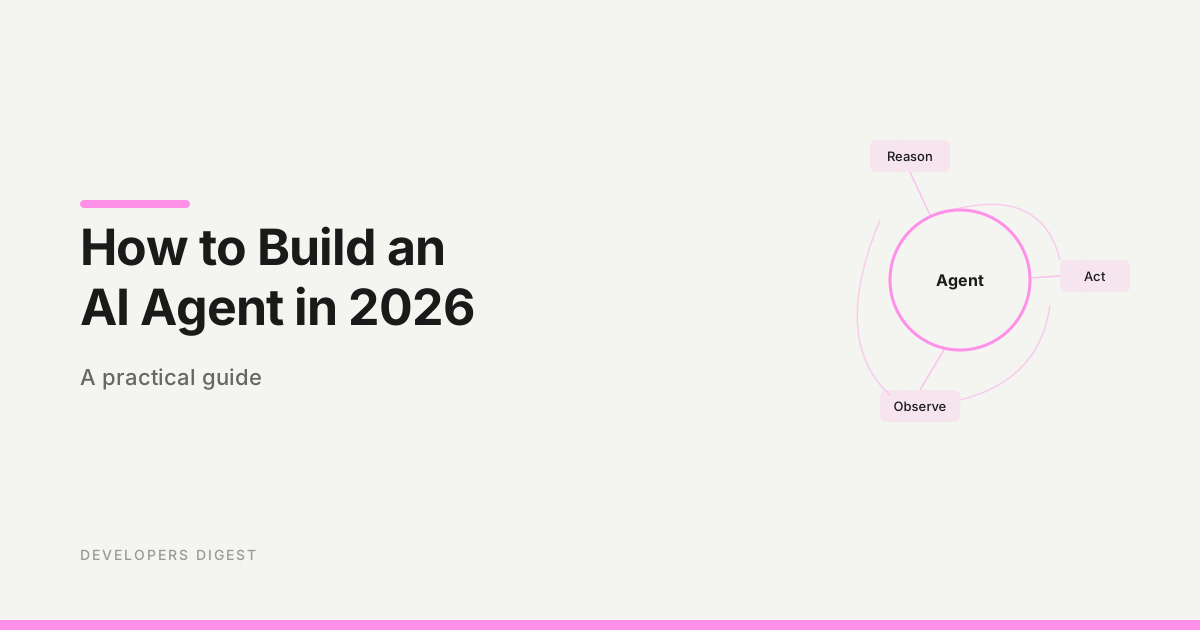
How to Build an AI Agent in 2026: A Practical Guide
A step-by-step guide to building AI agents that actually work. Choose a framework, define tools, wire up the loop, and ship something real.
10 min read
Ship Code While You Sleep: The Overnight Agent Workflow
How to spec agent tasks that run overnight and wake up to verified, reviewable code. The spec format, pipeline, and review workflow.
11 min read

AI Agents Explained: A TypeScript Developer's Guide
AI agents use LLMs to complete multi-step tasks autonomously. Here is how they work and how to build them in TypeScript.
6 min read

How to Build AI Agents in TypeScript
A practical guide to building AI agents with TypeScript using the Vercel AI SDK. Tool use, multi-step reasoning, and real patterns you can ship today.
10 min read

Multi-Agent Systems: How to Orchestrate Multiple AI Agents in TypeScript
From swarms to pipelines - here are the patterns for coordinating multiple AI agents in TypeScript applications.
6 min read

Open Source Has a Bot Problem: Prompt Injection in Contributing.md
AI coding agents are submitting pull requests to open source repos - and some CONTRIBUTING.md files now contain prompt injections targeting them.
3 min read

What Is MCP (Model Context Protocol)? A TypeScript Developer's Guide
MCP lets AI agents connect to databases, APIs, and tools. Here is what it is and how to use it in your TypeScript projects.
5 min read

CLIs Over MCPs: Why the Best AI Agent Tools Already Exist
OpenClaw has 247K stars and zero MCPs. The best tools for AI agents aren't new protocols - they're the CLIs developers have used for decades.
8 min read

OpenAI Agents SDK for TypeScript: A Practical Guide
OpenAI released their Agents SDK for TypeScript with first-class support for tool calling, structured outputs, multi-agent coordination, streaming, and human-in-the-loop approvals. Here is how each piece works.
9 min read

OpenAI Deep Research: The AI Agent That Does Your Homework
OpenAI's Deep Research is an AI agent inside ChatGPT that plans and executes multi-step research workflows, browsing dozens of websites and producing cited reports in minutes instead of hours.
7 min read

ChatGPT Tasks: Scheduled AI Agents Inside ChatGPT
OpenAI added scheduled tasks and reminders to ChatGPT, turning it from a chat interface into something closer to a personal AI agent. Here is how it works, what it can do today, and where this is heading.
8 min read

Gemini Deep Research: Google's AI Research Agent
Google's Gemini Advanced includes a deep research feature that searches dozens of websites, verifies information across multiple sources, and generates detailed cited reports. Here is how it works and how it compares to other AI research tools.
8 min read

Build an AI Agent Web App with LangGraph and CopilotKit
Wire a Python LangGraph agent into a Next.js frontend using CopilotKit's co-agent architecture. Full walkthrough covering the graph, search nodes, streaming state, and the React UI.
14 min read
Guides
All guides →Claude Code Setup Guide
Configure Claude Code for maximum productivity -- CLAUDE.md, sub-agents, MCP servers, and autonomous workflows.
GuideMCP Servers Explained
What MCP servers are, how they work, and how to build your own in 5 minutes.
GuideBuilding Your First MCP Server
Step-by-step guide to building an MCP server in TypeScript - from project setup to tool definitions, resource handling, testing, and deployment.
GuideAI Agent Frameworks Compared: CrewAI vs LangGraph vs AutoGen vs Claude Code
Deep comparison of the top AI agent frameworks - architecture, code examples, strengths, weaknesses, and when to use each one.
GuideKeep exploring AI Agents
- - OpenAI Agents SDK - recommended AI Agents tool from the Developers Digest directory
- - Compare Tools - dive deeper across the Developers Digest knowledge base
- - All AI Agents articles in the blog archive
- - Developers Digest on YouTube - video tutorials covering AI Agents and more

Get Smarter About AI Dev
New tutorials, open-source projects, and deep dives on coding agents - delivered weekly.
One email per weekReal code, not theoryFree forever
Explore 354 topics
Browse All Topics