DeepSeek V4 Economics: The Cost-Quality Frontier for Agentic Coding in 2026

TL;DR
DeepSeek V4 Pro lands an 80.6 on SWE-bench Verified in Max reasoning mode at $0.66/$1.98 per million tokens off-peak, and Flash runs agent inner loops at $0.22/$0.66. Here is the worked cost math, the Flash-vs-Pro split, and a clear guide on when to route to DeepSeek instead of a frontier model.
What Changed (August 2026)#
DeepSeek peak/off-peak pricing is now in effect (August 16, 16:00 UTC). The policy announced July 31 - 2x rates during peak hours (01:00-04:00 and 06:00-10:00 UTC, i.e. 09:00-12:00 and 14:00-18:00 Beijing Time) - landed with exact numbers: V4 Flash now bills at $0.22 input (cache miss) / $0.007 (cache hit) / $0.66 output off-peak, doubling to $0.44 / $0.014 / $1.32 during peak; V4 Pro at $0.66 / $0.022 / $1.98 off-peak, doubling to $1.32 / $0.044 / $3.96 during peak. The old flat $0.14/$0.28 Flash and $0.435/$0.87 Pro rates died August 16. The V4 Pro model also updated to DeepSeek-V4-Pro-0813 in the same window. Every figure in this post is re-based to the off-peak rates below, verified August 31, 2026 on the DeepSeek pricing page. The headline: even off-peak, output rates roughly doubled, so the cheap-agent math this post originally shipped with is now optimistic by about 2x on output-heavy loops.
Last updated: August 31, 2026
Last verified: 2026-08-31
The Cheap Model Got Good Enough to Argue About#
For most of the open-weights era, the cost-quality tradeoff was easy to call. The cheap models were cheap because they were worse, and on real agentic coding work - the long, tool-heavy loops where a model has to plan, edit, run, and recover from its own mistakes - the gap was wide enough that price barely entered the conversation. You paid frontier rates because the alternative did not finish the task.
DeepSeek V4 changed the shape of that argument. With V4 Pro scoring 80.6 on SWE-bench Verified in Max reasoning mode at an off-peak API price of $0.66 per million input tokens (cache miss) and $1.98 per million output, the question is no longer "is the cheap model good enough." It is "for which tasks is the quality delta worth the bill." That is a routing decision, not a vendor loyalty decision, and it is the one this post is built to help you make.
This is part of our ongoing AI-model-economics beat. If you want the full setup-and-API walkthrough, our DeepSeek V4 developer guide covers the SDK wiring, the thinking parameter, and the legacy alias cutover. If you want the head-to-head against the premium tier, Fable 5 vs DeepSeek V4 measures the cost-quality gap on real tasks. This piece is about the economics of routing agentic coding work to V4 specifically.
Official Sources#
Verify every figure below against primary sources before making a production decision. Prices and benchmarks move.
| Resource | URL | What You Get |
|---|---|---|
| DeepSeek Pricing | api-docs.deepseek.com/quick_start/pricing | Current per-million-token API pricing |
| DeepSeek V4 Pro Model Card | huggingface.co/deepseek-ai/DeepSeek-V4-Pro | Architecture, parameter counts, context limits |
| OpenRouter: V4 Pro | openrouter.ai/deepseek/deepseek-v4-pro | Third-party pricing and benchmark aggregation |
| OpenRouter: V4 Flash | openrouter.ai/deepseek/deepseek-v4-flash | Flash pricing and provider list |
| CloudZero DeepSeek Pricing 2026 | cloudzero.com/blog/deepseek-pricing | Independent pricing breakdown and cache notes |
| Verdent V4 Pricing & Migration | verdent.ai/guides/deepseek-v4-pricing-api-migration-2026 | Pricing history and migration context |
The Two Models, and Why the Split Matters for Cost#
DeepSeek V4 ships as a family, not a single checkpoint. The split is the entire economic story, so it is worth being precise about which model does what.
V4 Flash is the small, fast tier. The Hugging Face model card lists it at 284B total parameters (13B activated per token), and the July 31 refresh now ships as DeepSeek-V4-Flash-0731 - we covered what changed in the Flash 0731 agent update. Thinking mode is now the API default on both tiers; Flash can still run non-thinking for latency-sensitive inner loops, in the same range as the older deepseek-chat, and it is built for high-throughput work: classifiers, structured extraction, retrieval synthesis, and the inner loops of an agent where the model is making bounded, low-stakes decisions hundreds of times.
V4 Pro is the flagship. The instruction-tuned release weighs 1.6T total parameters (49B activated), and it is the model you reach for on hard reasoning: codebase-scale refactors, multi-step planning, and agent workloads that have to hold state across many tool calls. It is slower and several times more expensive than Flash, but it is still a fraction of closed-model pricing.
Both tiers share a 1M token context window and a 384K maximum output, the latter being a number nobody else is matching right now. For long-context agentic coding - dropping a whole repo into context and asking for a coordinated change - that 1M window is the feature that makes V4 a real frontier-model substitute rather than a budget fallback.
The Pricing Table#
These are the per-million-token prices listed on the DeepSeek pricing page as verified on August 31, 2026. The table shows the off-peak rates that are the floor for cost modeling; the peak/off-peak policy has been in effect since August 16, 2026 at 16:00 UTC, with peak hours at 2x off-peak (01:00-04:00 and 06:00-10:00 UTC). Some coverage still quotes V4 Pro at the pre-policy $1.74 / $3.48 launch reference price or the $0.435 / $0.87 flat rate; both are outdated. The official page is the source of truth.
| Model | Cache Hit (input) | Input | Output |
|---|---|---|---|
| DeepSeek V4 Flash (off-peak) | $0.007 | $0.22 | $0.66 |
| DeepSeek V4 Pro (off-peak) | $0.022 | $0.66 | $1.98 |
| Claude Sonnet (reference) | - | ~$2.00 | ~$10.00 |
| Frontier premium tier (reference) | - | ~$10.00 | ~$50.00 |
Peak rates, in effect during 01:00-04:00 and 06:00-10:00 UTC (verified August 31, 2026):
| Model | Cache Hit (input) | Input | Output |
|---|---|---|---|
| DeepSeek V4 Flash (peak) | $0.014 | $0.44 | $1.32 |
| DeepSeek V4 Pro (peak) | $0.044 | $1.32 | $3.96 |
Two things drop out of this table immediately. First, the cache hit price is a tiny fraction of the input price on both tiers, which means cache-friendly prompt structure - stable system context at the top, variable task at the bottom - quietly removes most of your input bill on any repeated workload. Second, V4 Pro output at $1.98 off-peak is roughly a fifth of Claude Sonnet's output rate and about a twenty-fifth of the premium-tier output rate. Output tokens dominate agentic coding bills because the model writes diffs, reasoning traces, and tool calls all day, so that output-side gap is where the real savings live. The policy change meaningfully reduced the gap versus the pre-August 16 flat rates, so any cost model written before that date needs re-basing.
A Worked Cost Example#
Abstract per-token numbers do not build intuition. Let us cost a single realistic agentic coding task end to end.
The task: a medium feature implementation across an existing TypeScript codebase. The agent reads relevant files, plans, writes the change across four files, runs the test suite, reads the failures, and patches twice before it goes green. This is a normal afternoon of agent work, not a toy.
Token profile for one run:
- Input: 600K tokens. Most of this is repeated codebase context fed back across iterations. With cache-friendly structure, assume 80 percent hits the cache (480K cached, 120K fresh).
- Output: 80K tokens of plans, diffs, reasoning, and tool calls.
V4 Pro cost for this run, at off-peak rates:
- Cached input: 480K x $0.022 / 1M = $0.0106
- Fresh input: 120K x $0.66 / 1M = $0.0792
- Output: 80K x $1.98 / 1M = $0.1584
- Total: about $0.25 per task run (about $0.50 if the whole run happens during peak hours)
The same run on a frontier premium tier (at the reference $10 input / $50 output, no cache assumed for the comparison floor):
- Input: 600K x $10 / 1M = $6.00
- Output: 80K x $50 / 1M = $4.00
- Total: about $10.00 per task run
That is roughly a 40x difference on a single task, and it compounds. An agent fleet doing 200 such tasks a day is the difference between about $50 and about $2,000 per day, or about $18K versus $600K annualized on that one workload. Against a mid-tier model like Claude Sonnet at $2/$10, the same run lands near $2.00, so V4 Pro is still about 8x cheaper off-peak.
The honest caveat: this math assumes V4 Pro finishes the task. If a harder problem causes Pro to fail where a frontier model succeeds, you pay the cheap bill twice and then pay the expensive bill anyway, plus the human time to notice. That failure-cost multiplier is exactly what the decision guide below is designed to price in. And one scheduling note: because peak-hour rates double, batch-able heavy work should be scheduled into off-peak windows (all hours except 01:00-04:00 and 06:00-10:00 UTC), where the rates above apply.
From the archive
Epic Games Releases Lore: A Version Control System Built for Game Development
Jun 17, 2026 • 7 min read
Everything Vercel Shipped at Ship 26 (June 2026)
Jun 17, 2026 • 8 min read
Factory Router, Explained: How Automatic Model Routing Cuts Coding-Agent Spend 20-25%
Jun 17, 2026 • 10 min read
Gemini CLI to Antigravity CLI Migration Guide: The June 18 Deadline
Jun 17, 2026 • 6 min read
Where V4 Sits on the Quality Axis#
The cost case only matters if the quality is real, so here is the benchmark picture. DeepSeek's own published numbers on the updated Hugging Face model card put V4 Pro at 80.6 on SWE-bench Verified and 87.5 on MMLU-Pro in Max reasoning mode (79.4 / 87.1 at the standard High effort). V4 Flash, refreshed July 31 as DeepSeek-V4-Flash-0731, lands at 79.0 on SWE-bench Verified and 86.2 on MMLU-Pro in Max mode, and still clears 73.7 on SWE-bench Verified with thinking off - well past R1-class reasoning at a fraction of R1's latency.
An 80.6 on SWE-bench Verified puts V4 Pro at the top of the open-weights leaderboard and, on DeepSeek's own comparison table, within a point of the best closed frontier models (Opus-4.6 Max: 80.8, Gemini-3.1-Pro High: 80.6). It does not top the leaderboard. The current frontier premium models still hold a slim edge on the hardest real-codebase tasks, and that edge is precisely what you are paying 50x output rates to buy when the task warrants it.
Treat vendor benchmarks as the optimistic case and validate on your own task distribution before you route production traffic. A model that wins on SWE-bench can still underperform on your specific stack, your conventions, and your tool surface.
When to Route to DeepSeek vs a Frontier Model#
This is the decision the whole post is built around. Route by task characteristics, not by habit.
Route to V4 Flash when:
- The work is high-volume and bounded: classification, structured extraction, retrieval synthesis, first-pass review, or the inner loop of an agent making many small decisions.
- Prompts repeat enough to benefit from cache hits, which collapse the input bill.
- Latency matters more than the last few points of quality.
- The failure cost of any single call is low because the loop self-corrects.
Route to V4 Pro when:
- The task is genuinely hard but the failure cost is recoverable: codebase refactors, multi-step planning, technical synthesis across many sources.
- You need the 1M context window to hold a whole repo or document set in one call.
- You are cost-sensitive at scale and the 8x-to-40x savings versus frontier tiers (at off-peak rates) move your unit economics.
- You can verify the output cheaply, so a rare miss is caught before it ships.
Stay on a frontier premium model when:
- The failure cost is high and hard to detect: production migrations, security-sensitive changes, anything where a subtly wrong diff is worse than no diff.
- The task lives at the top of the SWE-bench difficulty curve where the frontier still wins outright.
- You depend on provider-specific tooling - a particular agent SDK, computer-use surface, or harness integration - that V4 does not slot into cleanly.
- The per-task spend is small relative to the value at risk, so optimizing the model bill is the wrong thing to optimize.
The cleanest way to capture this in practice is a routing layer rather than a single default model. Run a smart orchestrator that triages tasks and dispatches the bounded ones to Flash, the hard-but-recoverable ones to Pro, and escalates only the genuinely frontier-grade work upward. We laid out the orchestrator-and-workers pattern in depth in the Omnigent meta-harness piece, which is the natural home for this kind of cost-aware dispatch. For a parallel cost-math treatment on a different cheap-but-capable model, the GLM-5.2 access and cost guide runs the same exercise for Z.ai's 1M-context coder.
The Self-Host Lever#
One more economic axis that frontier models cannot match: V4's weights are MIT licensed. Flash fits on a single high-memory workstation at 4-bit quantization, and Pro runs on a small cluster or a rented high-memory GPU box. For a steady, high-volume internal workload, self-hosting converts a per-token API bill into a fixed hardware cost, and above a certain throughput the fixed cost wins decisively. It also removes the data-egress and privacy questions that block some teams from sending code to any third-party API at all. That optionality has real value even if you never exercise it, because it caps your downside if API pricing moves against you.
The Bottom Line#
DeepSeek V4 did not win the benchmark crown, and it does not need to. What it did was push the cost-quality frontier far enough that "just use the frontier model for everything" stopped being the obviously correct default for cost-sensitive agentic coding. Flash makes the bounded, repetitive parts of an agent loop nearly free. Pro delivers near-mid-frontier coding quality at a fraction of the output price, with a 1M context window and a self-host escape hatch.
Route by task. Send the cheap, recoverable, high-volume work to V4 and reserve frontier spend for the high-failure-cost, top-of-curve tasks that actually justify it. Do the worked math on your own token profile, validate the quality on your own task distribution, and let the routing layer enforce the discipline. The economics in mid-2026 reward teams that treat model choice as a per-task decision rather than a standing subscription.
Frequently Asked Questions#
How much cheaper is DeepSeek V4 Pro than frontier models for agentic coding?#
On a representative medium feature task (about 600K input tokens with cache-friendly structure and 80K output tokens), V4 Pro costs roughly $0.25 per run at off-peak rates versus about $10.00 on a frontier premium tier at reference rates, a roughly 40x difference. Against a mid-tier model like Claude Sonnet at $2/$10, V4 Pro is about 8x cheaper on the same run. Output tokens dominate the bill, and V4 Pro's $1.98 output rate is where most of the savings come from. Run the same workload during peak hours and both figures roughly halve.
What is the difference between DeepSeek V4 Flash and V4 Pro for cost?#
At off-peak rates (in effect since August 16, 2026), V4 Flash costs $0.22 per million input tokens and $0.66 output, with cache hits at $0.007. V4 Pro costs $0.66 input and $1.98 output, with cache hits at $0.022. Peak rates double all of these during 01:00-04:00 and 06:00-10:00 UTC. Flash is built for high-volume bounded work like classification and agent inner loops; Pro is for hard reasoning and codebase-scale tasks. Both share a 1M context window and 384K max output.
Is DeepSeek V4 Pro good enough to replace a frontier model for coding?#
It scores 80.6 on SWE-bench Verified in Max reasoning mode, which puts it at the top of the open-weights leaderboard and within a point of the leading closed frontier models on DeepSeek's own comparison. It does not top the leaderboard, so the frontier still wins on the hardest real-codebase tasks. Route V4 the hard-but-recoverable work where you can verify output cheaply, and reserve frontier spend for high-failure-cost tasks.
When should I route a task to DeepSeek instead of a frontier model?#
Route to DeepSeek when the work is bounded and high-volume (Flash) or hard but recoverable with cheap verification and cost pressure at scale (Pro). Stay on a frontier model when the failure cost is high and hard to detect, the task is at the top of the difficulty curve, or you depend on provider-specific tooling. A routing layer that dispatches by task characteristics captures most of the savings.
Can I self-host DeepSeek V4 to cut costs further?#
Yes. The weights are MIT licensed. Flash fits on a single high-memory workstation at 4-bit quantization, and Pro runs on a small cluster or rented high-memory GPU box. For steady high-volume workloads, self-hosting converts a per-token API bill into a fixed hardware cost that wins above a certain throughput, and it removes data-egress and privacy constraints.
Continue Reading#
- DeepSeek V4 Flash 0731 agent update - what the July 31 Flash re-post-train changed: agent benchmarks, native Responses API, and first-party Codex support
- AI Model Routing Strategies for Cost-Effective Coding in 2026 - decision frameworks for routing between frontier and budget tiers by task complexity and cost budget
- DeepSeek Pauses Fundraising After Compute Gap Leak - the supply-side picture behind DeepSeek's compute constraints and what it means for API capacity
Sources#
- DeepSeek API Pricing - per-million-token pricing for V4 Flash and Pro, cache hit rates
- DeepSeek V4 Pro Model Card on Hugging Face - parameter counts, context window, MIT license
- OpenRouter: DeepSeek V4 Pro - third-party pricing and benchmark aggregation
- OpenRouter: DeepSeek V4 Flash - Flash pricing and provider list
- CloudZero: DeepSeek Pricing 2026 - independent pricing breakdown, cache and discount history
- Verdent: DeepSeek V4 Pricing & API Migration 2026 - pricing history and migration context
Read next
DeepSeek V4: The Developer's Guide to Flash and Pro
DeepSeek V4 splits into Flash and Pro, ships a 1M context window, and undercuts every closed model on price. Here's how to wire it up with the OpenAI SDK, when to pick it over Claude or GPT, and what changed since V3 and R1.
10 min readFable 5 vs DeepSeek V4: The Cost-Quality Gap Measured in Real Tasks
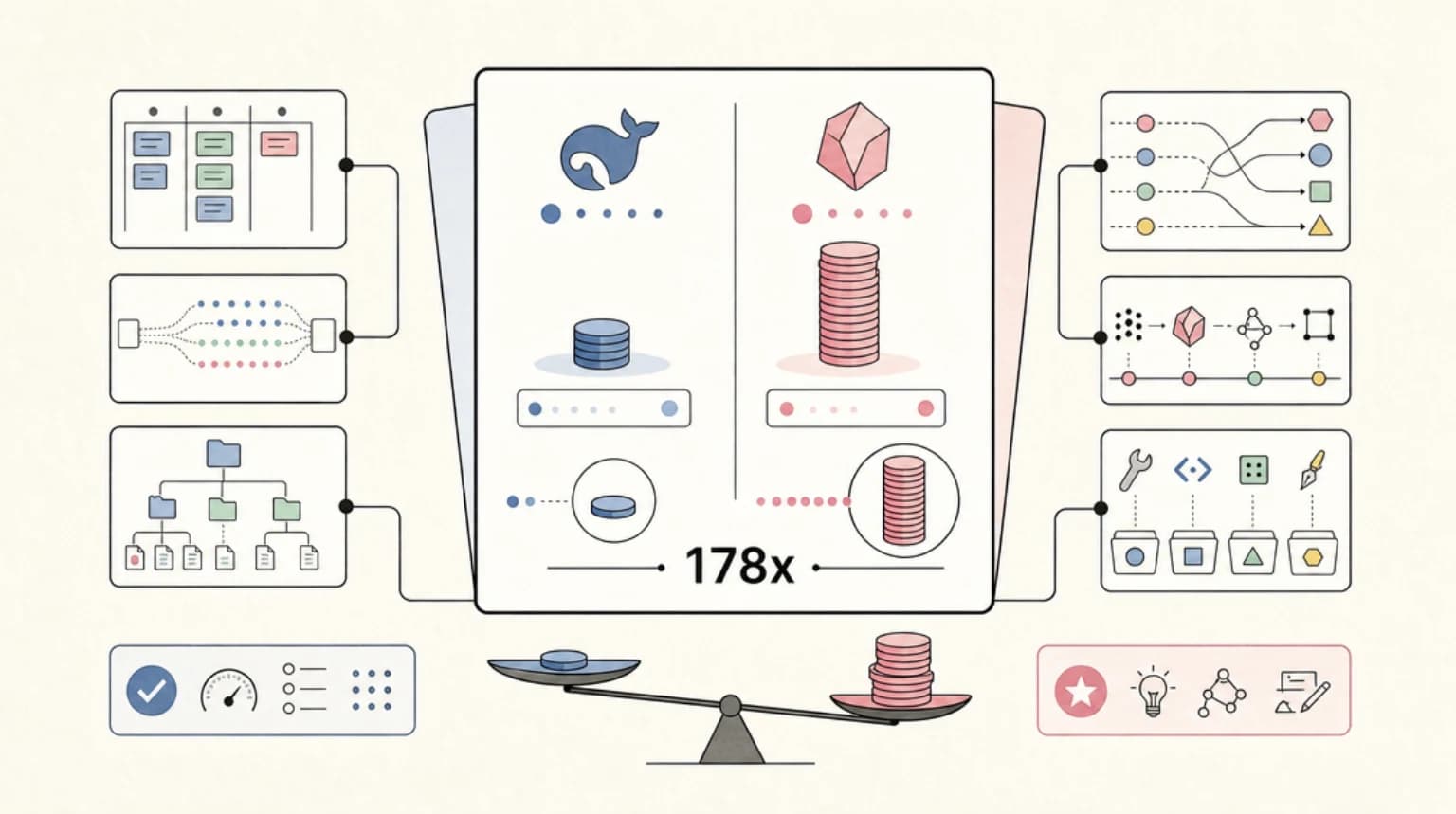
DeepSeek V4-Flash costs $0.28 per million output tokens. Fable 5 costs $50. That 178x gap is real - but so is the quality difference. Here is where it matters and where it does not.
7 min readWhere to Run GLM-5.2 Free and Cheap: Every Provider Compared (2026)
GLM-5.2 ships under an MIT license, so it is hosted everywhere - and a few places run it for free or nearly free right now. Here is every way to access Z.ai's open-weights coding model, from OpenCode Go referral credits and Devin to the cheapest per-token routes on OpenRouter, Fireworks, and DeepInfra, plus local Ollama.
10 min readShare
Developers Digest
Technical content at the intersection of AI and development. Building with AI agents, Claude Code, and modern dev tools - then showing you exactly how it works.
300+ videos30K+ GitHub stars850+ articles
Related Tools
AI ModelsOpen weights

DeepSeek V4
DeepSeek's open-weights frontier family, previewed April 24, 2026. V4-Pro is 1.6T total / 49B active params; V4-Flash is...
View ToolAI CodingOpen source
DeepSeek-TUI
Open-source terminal agent runtime with approval modes, rollback snapshots, MCP servers, LSP diagnostics, and a headless...
View ToolAI Models
DeepSeek
Open-source reasoning models from China. DeepSeek-R1 rivals o1 on math and code benchmarks. V3 for general use. Fully op...
View ToolAI CodingDaily Driver

Claude Code
Anthropic's agentic coding CLI. Runs in your terminal, edits files autonomously, spawns sub-agents, and maintains memory...
View ToolRelated Guides
Guide
Run AI Models Locally with Ollama and LM Studio
Install Ollama and LM Studio, pull your first model, and run AI locally for coding, chat, and automation - with zero cloud dependency.
Getting StartedGuide
PR Status in Footer - Claude Code
Clickable PR link in the footer with review state color coding.
Claude CodeRelated Videos

DeepSeek v4 in 4 Minutes
DeepSeek V4: 1M Context, 10x KV Cache Savings, and Ultra-Low Pricing DeepSeek released V4, highlighting major long-context efficiency gains: at a 1M-token context, V4 Pro uses 27% of FLOPs and 10% of...
Video·
The Agentic Development Tech Stack for 2026
Check out Clerk here: https://go.clerk.com/Bil2F6F As we approach the end of 2025, this video explores the monumental changes in coding over the past couple of years. Join me for a snapshot...
Video·
Introducing GPT-5 Codex: Optimized Agentic Coding for Developers
In this episode, we explore the newly released GPT-5 Codex by OpenAI, a specialized version of GPT-5 designed for agentic coding tasks. Codex offers advanced features, including enhanced code...
Video·
Related Posts
10 min read
DeepSeek
DeepSeek V4: The Developer's Guide to Flash and Pro
DeepSeek V4 splits into Flash and Pro, ships a 1M context window, and undercuts every closed model on price. Here's how...
7 min read
fable-5
Fable 5 vs DeepSeek V4: The Cost-Quality Gap Measured in Real Tasks
DeepSeek V4-Flash costs $0.28 per million output tokens. Fable 5 costs $50. That 178x gap is real - but so is the qualit...

10 min read
glm
Where to Run GLM-5.2 Free and Cheap: Every Provider Compared (2026)
GLM-5.2 ships under an MIT license, so it is hosted everywhere - and a few places run it for free or nearly free right n...
8 min read
ai-agents
Omnigent: Databricks' Meta-Harness for Orchestrating Claude Code, Codex, and Custom Agents
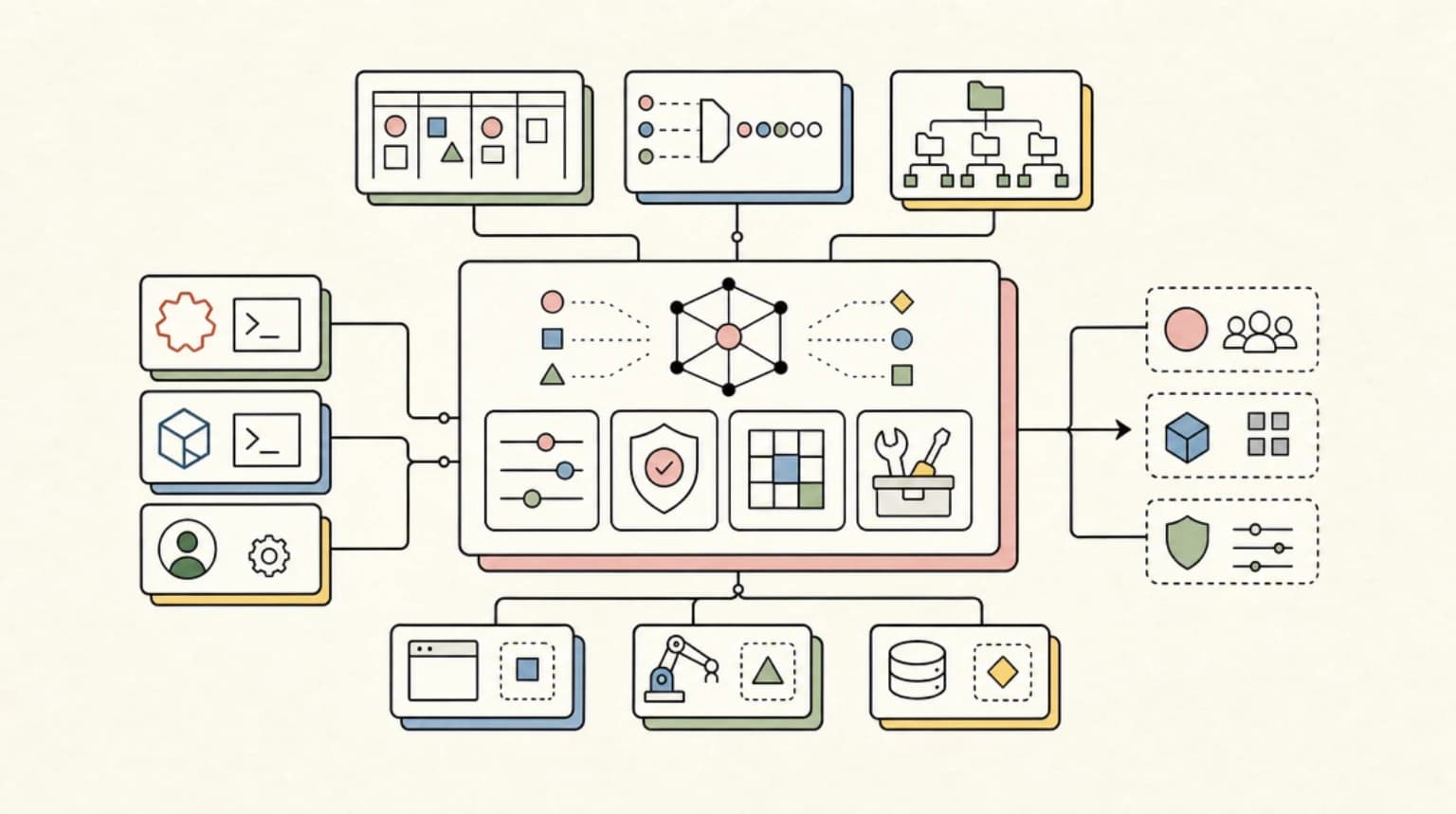
Databricks open-sourced Omnigent, a meta-harness that sits above individual agent CLIs so your sessions, policies, and s...
11 min read
pricing
Self-Hosting Open-Weights Models: The Real Break-Even Math
Open weights are free to download, but inference is not free to run. Here is the honest break-even math on when self-hos...
7 min read
deepseek
What the 'Notes on DeepSeek' Essay Gets Right About Open-Weights Economics
A first-hand visit to DeepSeek HQ reveals something more interesting than benchmark scores: a 300-person company that tr...
Build with the member tools
Get Smarter About AI Dev
New tutorials, open-source projects, and deep dives on coding agents - delivered weekly.
One email per weekReal code, not theoryFree forever